Published · Morgan Oaks Eternal Preserve
One of the more personal decisions in planning a green burial isn’t the cemetery or the service — it’s what the body rests in. For families new to natural…
One of the more personal decisions in planning a green burial isn’t the cemetery or the service — it’s what the body rests in. For families new to natural burial, the question often comes as a surprise: do you choose a shroud, or a casket? Neither is “more correct” than the other. Both are accepted, both are meaningful, and both return the body to the earth without synthetic materials, chemical treatments, or a lasting environmental footprint. The right choice usually comes down to what feels most true to the person being honored, and a few practical details worth understanding first.
What Counts as a Green Burial Container?
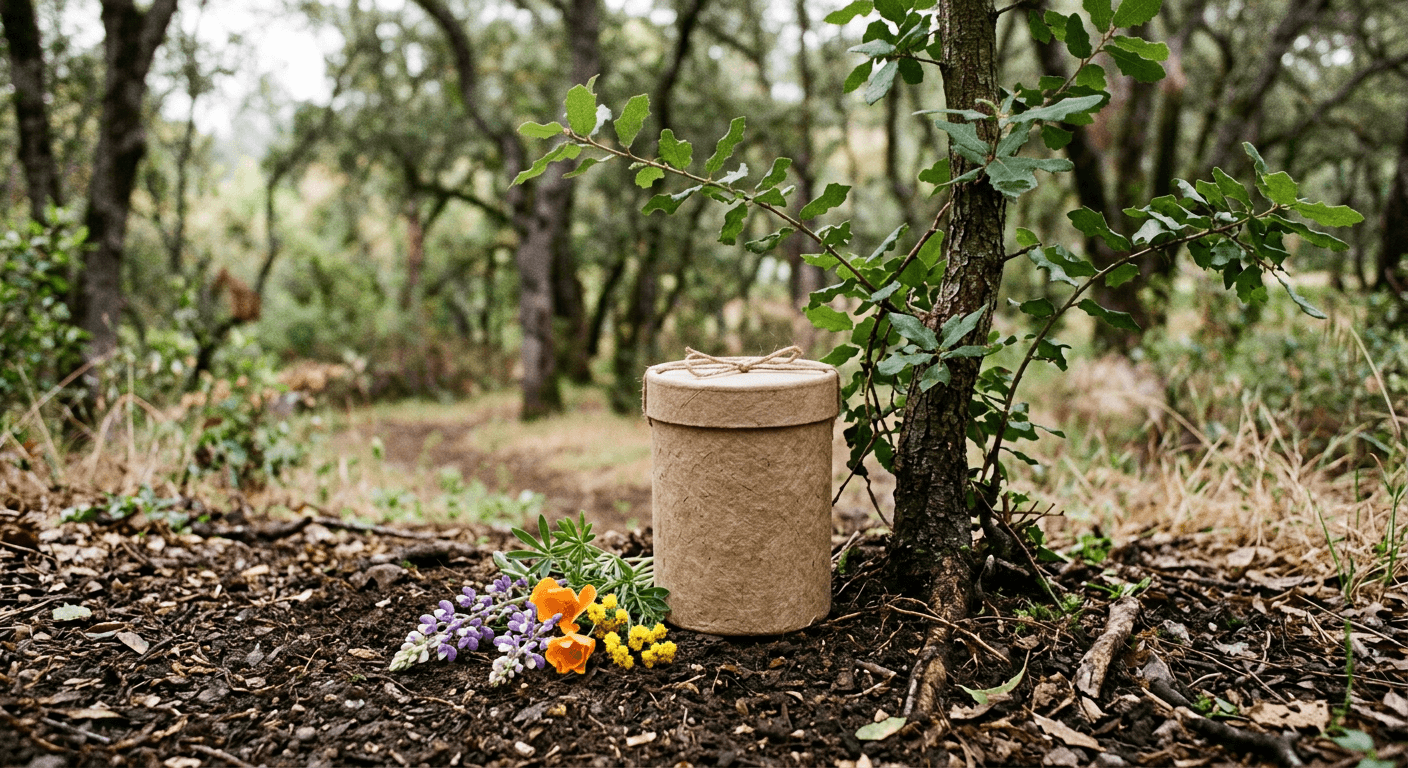
The Green Burial Council sets the standard that most natural burial grounds — including Morgan Oaks — follow: a casket, shroud, or urn is appropriate for green burial if it’s made from materials that are nontoxic and readily biodegradable, and if those materials weren’t harvested in a way that damages habitat. That standard rules out metal fittings, synthetic linings, plastic components, and chemical finishes, but it still leaves families with real choices.
Burial Shrouds: Simple, Natural, and Ancient
A shroud is a length of natural fabric used to wrap the body directly, without a rigid outer container. It’s one of the oldest burial customs in human history, practiced by cultures around the world long before caskets became standard.
Common shroud materials include:
- Unbleached cotton
- Linen
- Wool
- Silk
- Bamboo fiber
Why families choose a shroud:
- It feels closer to nature — no manufactured box, no hardware, nothing standing between the body and the earth
- It decomposes fully and quickly, with no wood, adhesives, or metal fasteners left behind
- It’s typically the least expensive option, since it requires no woodworking or construction
- Many people find the simplicity itself meaningful — a plain, honest goodbye without ornamentation
What to know practically: A shrouded body is usually placed on a rigid board or stretcher for transport and lowering into the grave, since fabric alone can’t support the body’s weight during handling. This isn’t a limitation of the shroud itself — it’s simply part of how the burial team safely carries out the process with dignity.
Biodegradable Caskets: Familiar Form, Natural Materials
For families who want the traditional look and structure of a funeral, without conventional casket materials, a biodegradable casket bridges both worlds.
Common biodegradable casket materials include:
- Untreated pine or other soft, local wood
- Willow (woven)
- Wicker or seagrass
- Bamboo
Why families choose a casket:
- It offers a more familiar visual experience for a viewing or traditional service
- It’s easier to handle during transport and lowering, especially for funeral homes accustomed to standard procedures
- It can feel like a gentler transition for family members who associate a shroud-only burial with unfamiliar imagery
- Woven and wood caskets can be personalized — hand-decorated, inscribed, or adorned with flowers and greenery from the burial site itself
What to know practically: A biodegradable casket still uses only wood, natural fiber, or plant-based materials — no metal hardware, no varnish, no glued veneers, and no non-biodegradable lining. It will decompose fully over time, just on a somewhat longer timeline than a shroud.
Shroud vs. Casket: A Side-by-Side Look
| | Shroud | Biodegradable Casket |
| --- | --- | --- |
| Typical cost | Lowest | Moderate |
| Decomposition speed | Fastest | Slower, but still natural |
| Handling | Requires a board or stretcher | Self-contained for transport |
| Viewing / traditional service | Possible, less conventional | More familiar format |
| Personalization | Fabric choice, wrapping style | Carving, decoration, engraving |
| Best for | Families wanting the simplest, most natural option | Families wanting tradition with sustainability |
Neither Choice Limits How You Honor a Life
It’s worth saying clearly: choosing a shroud does not mean a smaller or less meaningful service, and choosing a casket does not mean a less “green” burial. Both options meet the same environmental standard. Families can still hold a graveside service, a Celebration of Life, or a more traditional gathering either way — the container is one decision among many, not a statement about how much care went into the rest of the arrangements.
How to Decide
A few questions can help clarify the right fit:
- Will there be a viewing? A casket may feel more familiar for a traditional viewing experience.
- What did your loved one value? Someone who lived simply, or who felt strongly about minimizing their footprint, may have preferred the shroud’s simplicity.
- What’s the budget? A shroud is generally the most affordable option if cost is a significant factor.
- Does the cemetery have specific requirements? Every green burial ground has its own approved materials list — it’s worth confirming before you purchase anything.
Choosing With Confidence at Morgan Oaks
At Morgan Oaks Eternal Preserve in Placer County, California, our team keeps an approved list of caskets, shrouds, and local sources that meet Green Burial Council standards, so families never have to guess whether something qualifies. Whether you’re planning ahead or making arrangements for a loved one now, we’ll walk you through the options at your own pace, with honest guidance and no pressure either way.
Internal linking suggestions when publishing: link “Pre-Planning Guide,” “What is Green Burial,” “Tree Memorial,” and “Request a Tour” from within the body copy. Add FAQPage schema markup to the FAQ section for potential rich snippet placement in Google search results.